Australian Rental Yield Heatmap
Compare gross rental yields for houses and units, understand what moves the percentage, and investigate the market behind every high-yield result.
What is rental yield?
Rental yield expresses rent as a percentage of a property's value. It is a quick way to compare the income generated by differently priced properties, but the headline percentage is only the beginning of the analysis.
The map compares income before property expenses.
Heatmaps calculates gross yield by annualising the available weekly rent and dividing it by the corresponding property price. Gross yield is useful because the inputs can be compared consistently across many areas.
It does not deduct vacancy, property management, repairs, rates, insurance, land tax, finance costs or strata fees. Those costs vary by property and owner, so a 6% gross yield does not mean the investor keeps 6%.
- Gross yield: a screening and comparison measure.
- Net yield: income after relevant property expenses.
- Cash flow: the owner's result after expenses and finance.
Yield can move because rent changes, price changes, or both.
A rising yield is not automatically good news, and a falling yield is not automatically bad news. Read the rent and price together before interpreting the percentage.
This can reflect tight rental supply, stronger tenant demand or a change in the rental stock being observed.
An investor may accept yield compression when capital growth has increased the property's value.
A higher percentage may reflect weak buyer demand, local economic risk or falling asset values rather than stronger rent.
When rents and prices rise together, yield depends on which one grows faster over the measured periods.
The rent and price sides come from different sources.
Heatmaps combines state-specific rent and rental-bond data with separately processed property price and sales data. NSW, Victoria, Queensland and South Australia publish rent information through different government agencies, while other jurisdictions and coverage gaps require their own available source flows.
Those datasets can use different release schedules, geographic definitions, dwelling labels and sample sizes. The latest available rent quarter can therefore differ by state, and the price period used for yield needs to match that rent period where the data permits.
See the source list and processing notes in Data & Methodology.
Yield matters, but it does not have to be the only objective.
Investors need enough income and financial capacity to hold a property through vacancies, repairs and changing interest rates. Beyond that minimum, the preferred balance between yield and capital growth depends on strategy, buffers, borrowing position and time horizon.
Higher yield can reduce holding pressure
Investors with tighter serviceability or limited buffers may place more weight on rental income, while still checking whether the income is durable.
Lower yield may be acceptable with adequate buffers
An investor targeting long-term capital growth may accept a lower initial yield when the holding costs are manageable and the location has stronger growth drivers.
The highest percentage can lead to the wrong shortlist.
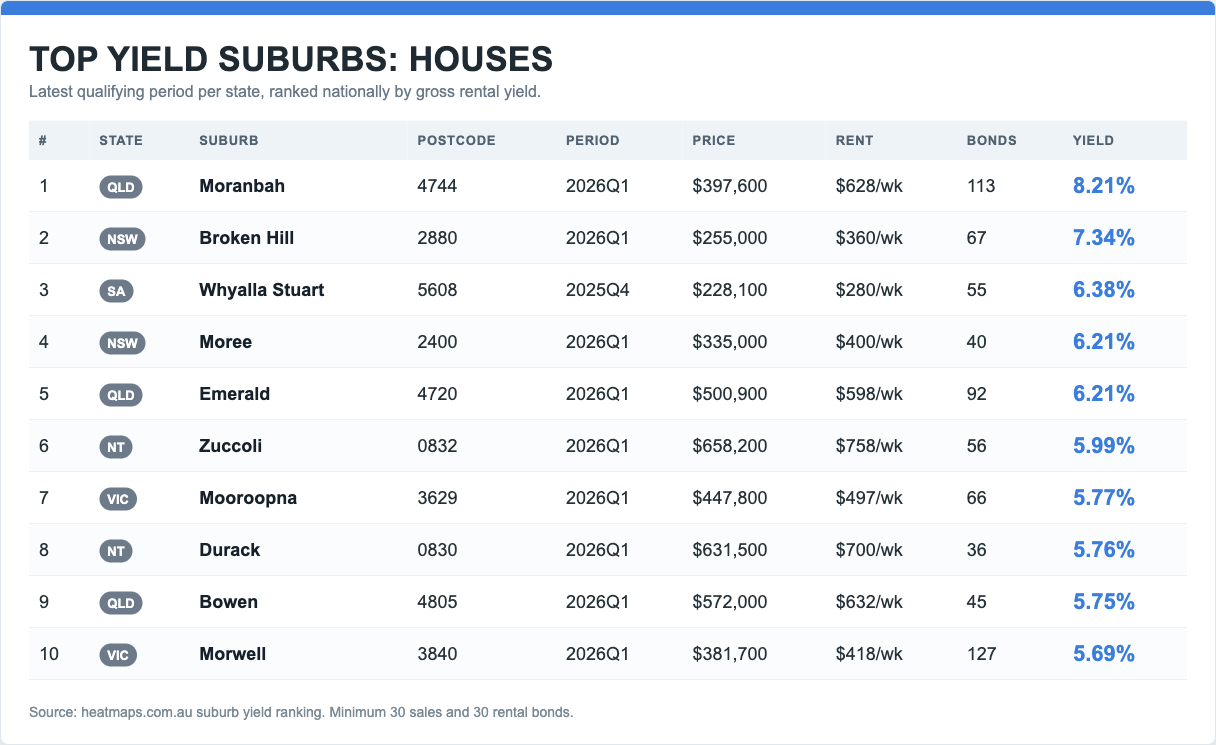
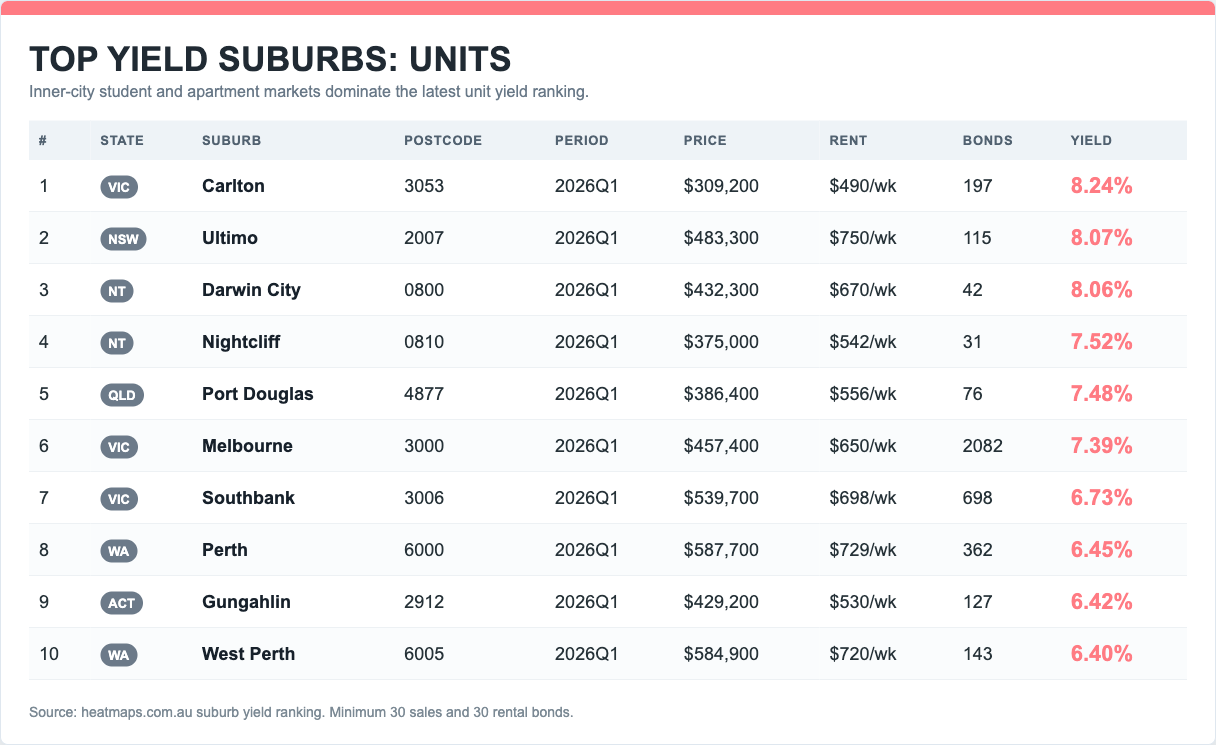
Sorting only by yield tends to surface cheaper remote markets, resource towns and specialised apartment precincts. Some are legitimate opportunities. Others compensate investors for risks that the formula cannot show.
Rents in resource towns can depend on one employer, project or commodity cycle.
Smaller markets may take longer to re-let or resell when local demand weakens.
A high yield can be produced by a falling or structurally weak purchase price.
Student, serviced or very small apartments can have unusual lending, strata and resale conditions.
Insurance, maintenance, strata and management can materially reduce the net result.
Strong rent today does not guarantee broad buyer demand or long-term price appreciation.
See how these patterns appear in the latest top-yield rankings.
Open the house-yield layer in your market.
Start with gross yield by suburb, then switch between houses and units and inspect the underlying rent and price timelines.
Use yield as a screening signal, not a return forecast.
Your property's achievable rent and value may differ from the area medians.
The calculation excludes property expenses, vacancy and finance.
Rent releases are not perfectly aligned across Australian jurisdictions.
Low observations or unusual dwelling mixes can distort comparisons.
Rental yield FAQ
What is a good rental yield in Australia?
There is no universal threshold. A useful yield depends on the property type, location, ownership costs, vacancy risk, finance and expected growth. Compare like with like and investigate why the percentage differs.
Why is gross yield higher for some units?
Units can have lower purchase prices relative to weekly rent, especially in student, CBD or compact-apartment markets. Strata and other ownership costs may reduce the advantage at net-yield level.
Can rental yield fall when an investment is performing well?
Yes. If the property's value rises faster than its rent, gross yield compresses even though the owner has gained capital value.
Does a high yield mean positive cash flow?
No. Positive cash flow depends on actual rent, vacancy, expenses, finance and the owner's tax position. Gross yield alone cannot answer it.
Compare Australian rental yields on the map.
Start with the percentage, then inspect the rent, price, period and local market before drawing a conclusion.